
A Compass for Contract Cash Flows
Please click the links below to view the full papers:
White Paper on the NUMA Protocol (Ver:2026-09-03)
On the third of August we published the first edition of the NUMA white paper, with a promise: to build a market for the cash flows of real commercial contracts — and to build it in public. On the third of September, we are back. We will be back on the third of every month from now on. A market that has never been systematically recognized cannot be built behind closed doors; its language, its rules and its instruments have to grow in front of the people who will one day rely on them.
Last month we described the map. This month we describe how people move across it: how financing parties and investors, starting from opposite ends of the market, actually meet in the middle — and the instrument that guides both.
The instrument is the subject of this note, so it is worth introducing properly. It is called the NUMA SHARP Twin Compasses: a Core Compass on the left, an Industry Compass on the right, and between them a single number — the Contract NUMA SHARP, the reading every listed contract finally presents to the market. (The name borrows from finance’s classic measure of risk-adjusted return; here SHARP stands for Structured, Honor, Ability, Ranked, Protocol. Reduced to its essence, it is one number: income divided by risk.)
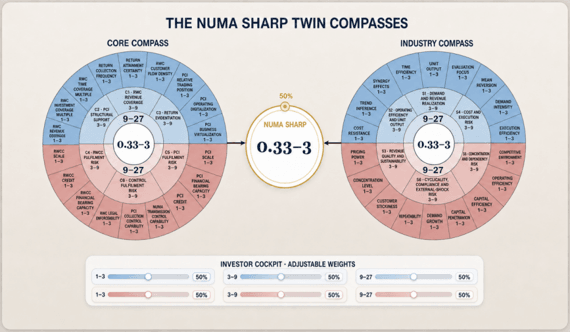
What the two dials measure, and why there must be two, is explained below. For now, hold on to one fact: every step in the story that follows is taken by someone reading these compasses. They are not decoration. They are how both sides navigate.
The financing side: three steps
Step one — you must be the first investor. Not everyone who wants funding is admitted. NUMA has one hard rule: whoever brings a contract to the market must already be that contract’s first investor — and the investment must have been made into an unrelated third party, not into oneself. The first investor has already committed money, goods or services to a counterparty whose business he has examined, whose risks he has weighed, and whose obligations he has papered — and in exchange holds a Contract Cash Right to participate in the transmission or distribution of that counterparty’s cash flows under the agreed terms of the transaction contract. Only then may he bring part of that Contract Cash Right to NUMA for discounting or assignment.
Five examples, five industries, one structure. A hotpot franchise chain installs equipment and know-how in a franchisee’s store in exchange for a share of future revenue. A computing-power company deploys a GPU cluster for an AI start-up in exchange for monthly rent. A concert promoter advances production and marketing costs in exchange for a split of the box office. A supply-chain firm finances a contracted hog farmer’s feed and piglets in exchange for the settlement proceeds at slaughter. An eldercare services company equips an independently operated nursing home with care beds and rehabilitation equipment in exchange for a share of future resident fees. In each case: invest into the counterparty first, then hold a Contract Cash Right to participate in the transmission or distribution of the counterparty’s cash flows under the agreed terms of the transaction contract.
Why insist on this design? Because it determines what risk NUMA’s investors actually bear. If a man could bring a contract on his own shop, funded by his own money, then whether investors get paid would depend entirely on how his business fares and whether he feels like sharing — indistinguishable from backing him directly. NUMA is not that market. The first investor has invested in someone else. He has every incentive to collect from that counterparty, and in doing so he performs the first layer of underwriting, screening and collection that transmits to NUMA's investors as agreed. What investors ultimately bear is counterparty risk — can he collect? — a risk that can be registered, scored and compared, rather than the conflicted, unanswerable question of whether his own business is any good. And if he collects but fails to pass the money on? That is precisely what the compasses exist to expose: collections control, transmission arrangements and record-keeping, layer by layer, in the open.
One corollary follows naturally. After listing, the first investor can almost never sell his entire position in a single transaction. Investors arrive in batches, discounting or taking assignments slice by slice. For a considerable period, therefore, the first investor’s interests and NUMA’s investors’ interests point the same way: he stays in the cash flow, with skin in the game, and if the contract stops paying he bears the pain alongside investors — first-loss in debt-like structures, pari passu in equity-like ones. Either way, he remains inside the risk. Investors can see at any time whether he is still in. In practice, only those who truly understand a contract will buy the last slices from him; most investors have no wish to buy him out entirely, because they want him to retain a stake that stays aligned with theirs. Anyone hoping to arrive with a slide deck and leave with other people’s money is not a customer of this market.
Step two — register the contract. The Contract Register is the market’s archive, updated far faster than any archive. Each registered contract keeps three layers. A static profile: nature, size, sector, counterparty, key rights and obligations — one authoritative answer to “who owes what to whom”. Six daily vital signs: projected cash flow, outstanding balance, shares sold and retired, weighted investor contribution, realised-versus-projected performance, days elapsed — published every day, so the gap between projection and reality accumulates in daylight. And a complete evidence archive: corporate filings, contract texts, payment records, and the full history of every update. The result is a prospectus that never goes quiet — and an investor who wants to spot-check any contract in a portfolio can drill to the bottom of that specific contract.
Step three — receive a reading. Once registered, the contract goes on the compasses. The Core Compass reads it as a contract — and note that every question on the dial is an objective measurement, not a judgement: what is the income coverage multiple over the financing amount? What objective markers of collection certainty exist? What are the counterparty’s characteristics? How is legal enforceability measured? How does the collections chain operate? The Industry Compass reads the business as a business, in the industry’s own vocabulary: table-turnover for hotpot, ticket-sales ratios for concerts, utilisation for computing clusters, feed-conversion and survival rates for hog farming. Each dial produces one reading; the two combine into the number in the middle — the Contract NUMA SHARP. That number is the financing party’s calling card to the market: a traceable and reproducible reading supported by underlying evidence.
Now, the compasses themselves
Enough context. Time to take them apart.
Why two compasses rather than one? Because every contract is two things at once: a contract, and a business. The first layer can be measured with one ruler across all industries — coverage, evidence, enforceability, control. That is the Core Compass on the left: stable by virtue of being universal. It does not change often; only market-wide developments of sufficient magnitude justify structural revision — neither immutable nor in daily flux. The second layer cannot share a ruler: table-turnover means nothing to a hog farm, feed ratios nothing to a concert. That is the Industry Compass on the right: a uniform skeleton (three income indicators, three risk indicators) beneath which each sector defines its own factors. Which is why there is not one Industry Compass but a wall of them — roughly 500 contract categories, roughly 500 Industry Compasses, each taken down when its kind of contract arrives. Left dial stable, right dial bespoke: together they hold a world that is half constant, half variable.
How to read them? From the rim inward, layer by layer:
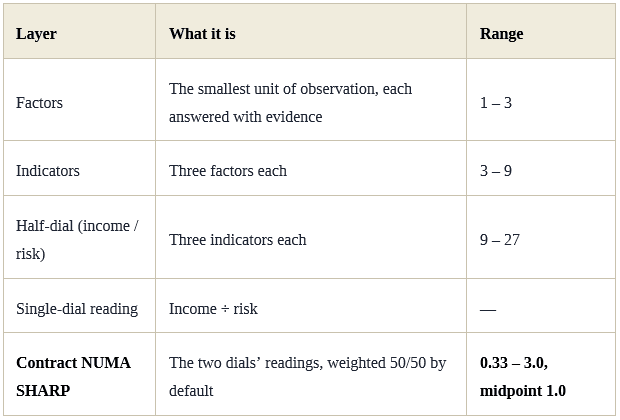
The numbers form a range, not a scatter: midpoint 1.0 and ceiling 3.0 today, expanding towards 0.11–9.0 as the data mature. Why only three gradations per factor, not nine from day one? Because a market this young cannot yet support nine-point distinctions on the evidence available; three points improve consistency and reproducibility while avoiding false precision. Once running data have validated each band, each point subdivides into three — today’s 1, 2 and 3 become tomorrow’s 1–3, 4–6 and 7–9. Today’s restraint is not the destination; it is the road map.
Every number, moreover, can be interrogated downward — which readings composed it, which factors composed those, which evidence sits beneath each factor. A score the market cannot recompute is an opinion; a score it can recompute is infrastructure. NUMA is building the second kind.
Two boundaries deserve equal emphasis. Zero is not a score; it is a gate. A contract that breaches a minimum admission standard — coverage below threshold, a first investor retaining no economic interest, a party with an active delinquency record — scores zero and does not list; it never reaches the compass. And a blank is not a zero. Where evidence has not yet arrived, the factor is left blank and disclosed as such, with the reading computed proportionally from factors that do have evidence. A blank is itself information: it tells you the evidence has not yet spoken.
The investor side: three steps
Step one — entry through licensed intermediaries. Identity verification, anti-money-laundering and suitability are performed by licensed institutions under their rules: who may buy which cash flows, and how much risk they may take, is judged by licensed firms. The market’s own job is narrower and more useful: to make each contract’s evidence, scores and rules machine-readable, so that due diligence has, for the first time, standardised raw material.
Step two — orders are operations on the compasses. An investor’s order is three sets of instructions, not a single “how much”. The base order states what you want: category, budget, target yield, tenor, minimum reading. The supplementary order states what you exclude. The weighting order states how you see — and this third set is the bank of levers on the console. The relative weight of the two dials is yours to set: 60 per cent on contract structure if that is what you trust, 60 per cent on business quality if you prefer. So is the relative weight of income and risk; so, within each dial, are the weights of individual factors. The official reading is always computed at 50/50, uniform for the whole market and fully logged; your adjustments live only in your own cockpit view. They change neither the market’s published reading nor anything anyone else sees.
That is the real meaning of the investor cockpit: the wheel, the dials and the levers are in your hands, and the number in the middle is one you watched yourself set. The compasses make no decisions for anyone; they let everyone who decides first see where they stand.
Step three — the portfolio gets its own reading. Orders are matched in batches after the close, under rules published in advance, and settle into a portfolio (a PCCP). The portfolio carries its own Portfolio NUMA SHARP — and it is not a weighted average of its contracts. Each contract’s concentration contribution, correlation exposure and cash-flow complementarities change when it sits alongside fifty others, and must be re-evaluated in the portfolio’s own context: a contract that looks unremarkable alone may become critical when it comes to portfolio diversification. Three views stand side by side and never overwrite each other: the market’s default equal weights, the weights revealed by actual holdings, and your own.
Where the two sides meet
The two lines of the story now converge. From the left comes the financing party: first investor, then registration, then a Contract NUMA SHARP. From the right comes the investor: licensed entry, then orders, then a Portfolio NUMA SHARP. Both arrive speaking the same language, and the meeting point is the PCCP.
One feature of that meeting is worth spelling out. Each contract, once divided into shares, lands in the portfolios of many investors. And each investor holds a few shares of thousands, potentially tens of thousands, of contracts at once. Every contract sits inside many portfolios; every portfolio contains many contracts. That many-to-many mutual holding will be the defining feature of NUMA’s market.
That, in full, is the story the September white paper tells: a two-sided journey, navigated on the NUMA SHARP Twin Compasses. Nobody travels blind. The financing side knows how a contract must be presented; the investing side knows what it is looking at; and every number in between lies in the open.
From map to compass
A month ago we promised a map and coordinates for the contract market. The map says where the market is; the coordinates say where each contract sits. The compasses answer the third question: how to look.
The three pieces are now on the table, and the next steps differ by dial. The Core Compass is essentially settled: it governs what is common to all contracts and will remain stable barring market-wide change. The Industry Compasses are about to multiply: this edition already works through five full sector cases — hotpot franchising, computing-power leasing, concert promotion, hog farming and more — and from today we are compiling Industry Compasses for each of the roughly 500 contract categories in the asset taxonomy, planned for full release in the next edition on 3 October — “1003”, in this market’s calendar. A handful of compasses hang on the wall today; next month there will be nearly five hundred.
And while those five hundred are being built, we are pressing ahead with the market’s other infrastructure — the payment and settlement system, delivery arrangements, and the rest — each to be published as it is completed, on the third of the month to come. All of it serves a single goal: to bring the market to full launch as early as possible.
We will report back on 3 October.
— NUMA · See you on the 3rd