
Micro Connect New Markets (NUMA) White Paper October 3, 2026 Edition
Please click the links below to view the full papers:
Micro Connect New Markets (NUMA) White Paper October 3, 2026 Edition
HAT over MASS
Micro Agents · Simple & Short tasks
Measurement Infrastructure for the Contract Economy:
Theory, Factory, and Samples
“Govern the Individual | Unleash the Collective”
Executive Summary
HAT over MASS is the third white paper from Micro Connect New Markets, dated October 3, 2026. Each of the three white papers stands on its own and advances the discussion: the August 3 white paper (8·03) sets out the market framework for investment and financing based on contractual cash flows, answering "What kind of market should be built?"; the September 3 white paper (9·03) sets out the measurement rules for the two Compasses, answering "How do we understand and measure contracts and businesses?"; the October 3 white paper (10·03) addresses the next question: Who performs this professional work, and how is it organized, inspected, and continuously improved?
I. Who Is Micro Connect New Markets (NUMA)?
Micro Connect New Markets provides Registration and Measurement Infrastructure for the contract securitization market. This white paper describes six core tools within that infrastructure as "instruments," while the organization that builds and maintains these instruments is described as an "AI factory": HAT over MASS. People set the rules and bear responsibility; AI collaborates through assigned tasks so that the development and maintenance of the tools are traceable and open to inspection. The six instruments work together across the lifecycle of a contract, from admission through its ongoing term. The development status and scope of access for each instrument are governed by its official version and actual disclosures.
1. The Contract Terminal is the first stop for contract admission. The system collects the required materials, enters and verifies each item, and requests additional information or clarification where materials are missing, inconsistent, or fail to meet requirements. It organizes nonstandard commercial contracts into structured, verifiable records that meet admission requirements. It continuously collects and checks information, retaining its source, timestamp, and verification status. The system automatically flags missing or conflicting information; AI inference must not be used to fill gaps in the facts. The contract must be lawful and compliant, in force, and genuinely being performed, with cash flows verifiable by a third party. Once these admission conditions are met, investment suitability must still be independently assessed using the specific evidence.
2. The Contract Registrar organizes collected and verified contracts into standardized records that can be registered, queried, and compared, identifying the contracting parties, agreed terms, and current status and linking to the underlying materials. When terms or status change, the basis for the changes and historical versions are retained. Registration does not change contractual rights or obligations or guarantee contract performance.
3. The Contract Compass measures registered contracts: the Core Compass examines contract structure; the Industry Compass examines the business behind the contract. Each has a Return Dimension and a Risk Dimension, presented separately, without addition or offsetting. Factor definitions, data sources, Rule Versions, and scoring methods are explained with the corresponding official version for professional institutions to review.
4. Compass Reading updates Factor data for registered contracts daily and updates readings according to the nature of the data and new evidence. It continuously records changes in business operations and contract performance, specifies timestamps and Observation Periods, and retains records before and after each update. When there are no new facts, the existing readings and their timestamps are retained; daily checks alone do not change the values.
5. Once investors have completed transactions and settlement through licensed institutions, the Contract Portfolio Registry records daily which contracts each portfolio holds, the quantities held, and changes in those holdings. The Order Register retains original trade and holding facts; the Contract Portfolio Registry links those records at the portfolio level. It records holding relationships and changes and does not provide custody of client assets. Simulated allocations and actual holdings are separately identified and kept in segregated records, so they are not mixed under the same holding measure.
6. The Compass Terminal is a professional interface for queries and analysis by licensed institutions or qualified overseas investors. Users retrieve readings, compare materials, and trace their supporting basis under their own methodologies to form their own judgments. Access to the professional terminal requires the appropriate qualifications and authorization and is unavailable to the public. The public may read general industry research materials; these two forms of access are managed separately.
This instrument system serves both investors and financing parties. On one side are operating entities such as shops, factories, and farms acting as contract issuers. They provide contract materials and operating information organized by Micro Connect New Markets so that professional institutions can understand, measure, and verify them. On the other side are Micro Connect New Markets investors, comprising licensed institutions or qualified overseas investors, which use the tools provided by Micro Connect New Markets to extend professional judgment to more businesses of smaller scale. Investment decisions are made by parties with the relevant decision-making authority. Licensed institutions fulfill the obligations associated with their respective functions within the scope of their licenses.
Readings are not ratings. The compass points north; it does not prescribe a route.
Micro Connect New Markets provides verifiable, continuously updated records and data points. It does not rate the credit quality of contracts or recommend assets to investors. Scores cannot be interpreted as rates of return, default probabilities, or credit ratings. Investors may refer to Compass readings to assess asset quality, but they bear the investment risks themselves.
II. Three White Papers and Six Instruments
Micro Connect New Markets uses six instruments to register, measure, and continuously track contract information. The terminals support interaction and access; between them, registries preserve facts, Compasses provide measurement, and readings track change. The six instruments have distinct functions and can call on one another during business processes; they need not be used in a fixed sequence: the Compass Terminal can support professional consultation throughout, while portfolio registration records actual holding relationships after transactions and settlement are complete. The 8·03 white paper sets out the market framework, and the 9·03 white paper develops the registration and measurement functions. This white paper further integrates those functions into a six-instrument system and uses HAT over MASS to explain how the organization supporting their development and maintenance operates.
The instruments are for people to use; the factory gives their development and maintenance rules, inspection, and accountability.
III. The Problem: How Can Professional Expertise Reach Small Businesses?
Corporate securitization organizes the rights and responsibilities that capital needs to participate in business operations at the company level. When investment and financing focus on individual contracts, due diligence, verification, pricing, and monitoring must still be completed item by item, yet a single small business may be unable to bear the professional cost. A contract specifies cash flow arrangements, but whether those commitments can be fulfilled and payments actually recovered still requires ongoing verification. Previously, professionals handled matters one by one. The finer and more numerous the tasks, the harder it was to make the economics work. AI may lower the cost of repetitive work such as organizing materials and checking rules, giving professional expertise an opportunity to reach smaller businesses.
IV. How the Instruments Are Built: HAT over MASS
HAT over MASS: Govern the Individual, Unleash the Collective
The factory that builds and maintains this instrument system is called HAT over MASS. MASS combines Micro Agents with Simple & Short Tasks and also draws on the English word "mass" to convey scale: it organizes vast numbers of Agents to undertake Microtasks that can be independently inspected. HAT stands for Human-Commanded, AI-Operated, Trust: a trust mechanism in which people exercise control and AI performs the work. People establish, amend, and revoke the rules. Each AI Organizational Position has a named human accountable owner through Named Human Accountability Assignment. AI executes within its authorization. Governance Hats govern boundaries, not actions. When rules are absent, authority would be exceeded, or human discretion is needed, the affected execution pauses and the matter is referred to a human with the appropriate authority.
"Micro" refers to task granularity, not model capability. Breaking work into small tasks makes boundaries clearer and results easier to inspect; collaboration at scale lets full model capabilities realize their potential across different tasks. Governance-to-Agent Control safeguards rules and boundaries; Agent-to-Agent Collaboration handles assignment, execution, and review.
The ambition is "large pools of capital put to small-scale use"; the obstacle is "top talent cannot economically serve small tasks"; the answer is "powerful capabilities put to small-scale use."
The Twelve Sufficiency Conditions constrain the organization in four areas: tasks must be sufficiently small, narrow, and granular; foundations must be sufficiently diverse, cross-checked, and cost-effective; staffing must be sufficiently numerous, fine-grained, and counterbalancing; inspection must be sufficiently comprehensive, long, and deep. If any condition fails, a warning must be issued, the gap identified, and recalibration performed. Rule blind spots, data contamination, Common-Source Bias, and the propagation of erroneous judgments must be identified and addressed continuously. Judgments that cannot be broken into Microtasks are assigned to humans with the appropriate authority; AI may provide information and analytical support within its authorization.
Place powerful AI under a firm Governance Hat established by people.
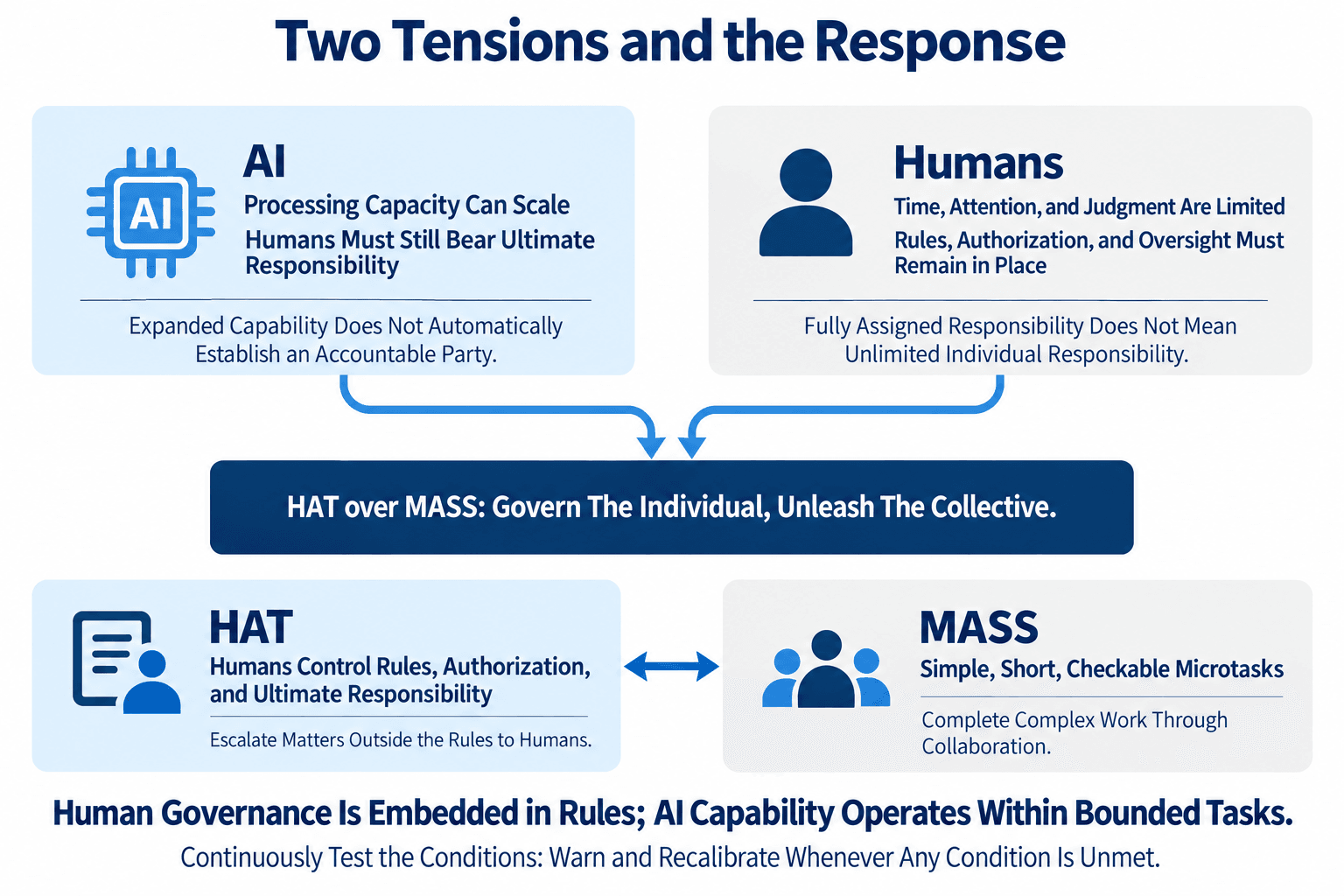
Figure 0-1: Two Sets of Tensions in the AI Era and the Response of HAT over MASS
V. The AI Factory Today
The 5,000 AI employee positions have been entered in the organizational register across four functions: Administration, Business, Control, and Deployment. "Taken up their positions" means that the positions have been entered in the organization's register; it does not mean 5,000 instances are running simultaneously.
AI Employee is the external designation for a position; an AI Organizational Position is a stable organizational identity. When a task arrives, the system starts an Agent according to the requirements of the position and calls on the capabilities needed for that run. The Agent Identifier (Agent ID) links the position to its accountable human, and the Agent Capability and Performance Profile informs scheduling. Each instance run generates a corresponding Run Identifier linked to its task and to the inputs, outputs, calls, and inspection records for that run. A single task can involve multiple instances and repeated rework. Teams may be disbanded; identities and records are retained.
From task intake to archiving, seven stages form a delivery workflow and preserve the basis and responsibility for each step.
For example, a task to generate the Compass for chain convenience stores first defines its scope and delivery standards, then splits into work units such as Factor identification, specification of measurement bases, and Scoring Rules. It proceeds through seven stages: task intake, Rule Matching, team formation, execution, validation, Deliverable Consolidation, and archiving. Each stage records inputs, rules, outputs, and exceptions. Problems are first located and clarified; where changes are needed, work is returned to the appropriate stage for revision and reinspection. SIM-01 in this white paper is an illustrative simulation, not an actual operating result. The progress and inspection status of real tasks are established by retained execution and acceptance records.
VI. Deliverables to Date: 500 Industry Compasses
Each Industry Has Its Own Scale: Compass Deliverables for Five Hundred Industries
The Industry Compass rule deliverables in this edition cover 500 industries. The main text examines chain convenience stores, Sichuan-Chongqing hot pot restaurants, and freshly prepared tea beverage stores in detail; Appendix I includes 17 additional category cases, making 20 in total. These 20 cases are offered for detailed reading; they are not a statistical sample. Rule coverage for 500 industries does not mean that enterprises in those industries have been scored. The current cases show Indicator and Factor structures. Before enterprise application, users must still check the applicable version, measurement specifications, data sources, Observation Period, weights, and scoring standards, then collect data, conduct actual scoring, and perform backtesting. Released industry deliverables and version materials are available through the links.
For a score to withstand scrutiny, it must first specify what is measured, how it is calculated, and how long it is observed, then state which conditions fall into which score band. Applying the same rules to the same data should reproduce the same result. The Return Dimension and Risk Dimension are expressed separately, without addition or offsetting: readers must see both where operational support is strong and where risks lie.
The Industry Compass uses "3 Industry Perspectives + cross-checking by 3 models": the Ordinary Operator, Industry Veteran, and Adversarial Manipulation Perspectives examine the business from different positions. The Adversarial Manipulation Perspective looks for ways to dress up a business or game its scores. The three models form judgments separately before their assumptions, evidence, and differences are compared.
The Six Review Perspectives and Eligibility and Composition Review conduct design review, eligibility assessment, and Factor combination selection for candidate industry Factors. The six perspectives examine business relevance, reproducibility of calculations and scores, credibility of data sources and collection paths, the basis for distinguishing cases, incremental information relative to the full Factor pool, and resistance to manipulation. Eligibility and Composition Review uses these findings to assess candidate eligibility and then select combinations from the eligible pool. A candidate's "eligible for selection" status does not mean final selection, much less completed enterprise validation.
Industry research is divided into Microtasks and advanced in parallel. Multiple perspectives propose candidate judgments, multiple models cross-check them, the Six Review Perspectives review them, and Eligibility and Composition Review selects them. This accelerates the development of 500 Industry Compasses, with each deliverable retaining the basis for inspection and revision.
VII. Next Steps: Validation, Calibration, and Simulation
The next phase has four areas of work. First, enterprise data collection and actual scoring will ground readings in verifiable operating data. Second, backtesting and calibration will use operating and performance outcomes to examine Factors, thresholds, and coefficients; problems will be diagnosed before the relevant revisions are made. Third, the entire system will run continuously in an environment explicitly marked as simulated, linking registration, measurement, task handoffs, inspection, alerts, and response, and incorporating adverse scenarios. This will test whether the stages work together and whether exceptions can be detected and handled. Fourth, development updates will be published to the market on the 3rd of each month, stating what has been done, how far it has progressed, and what evidence is still missing, according to actual progress. The rule deliverables for 500 industries are a starting point; enterprise application and ongoing inspection must still establish whether the rules are applicable and the readings reliable.
Simulated contracts, funds, allocations, and results must be clearly labeled and managed separately from real transactions and holding records. The invitation in 9·03 also sets the direction for the subsequent simulation experience:
Your Order. Your Portfolio. Your SHARP.
VIII. Oversight and Inspection of HAT over MASS
Micro Connect New Markets actively embraces and complies with regulation and provides verifiable rules, system records, and execution records for regulatory inspection. This white paper explains inspection of HAT over MASS through oversight of people, examination of the system, and review of standards. Oversight of people checks each position's Named Human Accountability Assignment, authorization, and records of rule establishment, amendment, and revocation. Examination of the system checks task inputs, Rule Versions, execution, inspection, and exception handling records; inspection interfaces, replay capabilities, and their limitations are described according to actual development. Review of standards checks whether evidence supports the Twelve Sufficiency Conditions and whether warnings and recalibration occur when conditions are insufficient. People govern rules and exceptions; the system governs execution and recordkeeping; independent inspection checks whether outputs and processes meet requirements.
People bear responsibility under regulatory requirements and manage the system through rules and authorization; the system organizes execution under those rules and retains records. This division applies system governance to the AI factory. Human work centers on rules, authorization, supervision, and exception handling; professional confirmation and human discretion required by law or institutional rules remain with people who hold the corresponding responsibilities.
IX. Division of Responsibilities with Licensed Institutions
Investors complete transactions through institutions holding the appropriate licenses. Investment decisions are made by parties with the relevant decision-making authority; investor suitability, related services, and compliance obligations are handled by licensed institutions performing those functions within the scope of their licenses. After transactions and settlement are complete, actual holding relationships are entered in the Contract Portfolio Registry and linked to original trade records. The Contract Registrar records the contract itself and its status, Compass Reading is updated on the basis of new facts and evidence, and the Compass Terminal serves licensed institutions or qualified overseas investors with the appropriate qualifications and authorization.
Micro Connect New Markets is responsible for registration, measurement, and the infrastructure for using these materials. It does not select assets or allocate holdings for investors. Contract registration is based on collected and verified contract information. Portfolio registration is based on completed transactions, settlement, and subsequent changes in holdings. Versions and supporting bases are retained for rules and records. Micro Connect New Markets is not a securities company; it does not match trades, list securities, establish pools of client funds, or handle client assets. Micro Connect New Markets is responsible for the soundness of its own system governance and the reliability of its infrastructure: data errors must be corrected with historical records retained; the effects of system exceptions must be identified, the faults corrected, and the affected functions reinspected; problems in Factor definitions and rules must be revised through governance procedures. The absence of a commitment to investment outcomes does not remove responsibility for registration, data, systems, and services themselves.
The public may read general industry research materials. Formal investment participation is available only to licensed institutions or qualified overseas investors meeting the requirements of the applicable jurisdiction, through appropriately licensed intermediaries, and is unavailable to retail investors. No fundraising is conducted within China, and domestic funds are not accepted for investment participation.
X. How to Read and Help Improve This White Paper
The main text has six parts: the business challenge, Compass tools and rules, HAT over MASS theory, the AI work manual, case deliverables and the outlook. General readers can use Parts I and II to understand the problem and instruments, and Part III to understand how HAT over MASS is organized. The work manual in Part IV sets out responsibilities for the named humans accountable for AI positions and enables technical due diligence parties and AI auditors to inspect organizational and operating arrangements. Operators, industry experts, and investment researchers may start with Part V and Appendix I. Subsequent validation arrangements appear in Part VI.
Trust has no passbook; it is settled daily.
Micro Connect New Markets discloses its methods, deliverables, and boundaries so that the market can raise specific questions.
Whether Factors capture what matters to a business, whether data can be obtained and verified, whether rules allow score manipulation, and what should change when counterexamples arise can all be discussed item by item. Each evidence-based revision should bring the methodology closer to real operations. Industry coverage still cannot replace verification of specific projects and ongoing observation.
The map is gradually unfolding, the compasses continue to be calibrated, and the organization has taken up its positions.
Micro Connect New Markets invites business operators, industry experts, financial institutions, and AI technology partners to contribute, and welcomes guidance from regulators, so that the methodology continues to improve through practice and inspection.
> Access to Industry Compass Deliverables <
Start with the 3 cases in the main text and 17 in the appendix, then explore Compass deliverables for 500 industries
Readers can scan the QR code below, register the requested information, and complete verification to view Indicator and Factor structures, released rule materials, and version descriptions by industry. Current access for each industry is governed by official disclosures.

Note: Online viewing only; downloads are unavailable
Industry Compass website: https://microconnect.com/industry-compass